



Navigating 2030 Targets with Commercial Common Sense
Smart Optimisation at PwC’s One Spencer Dock, Dublin. A previously optimised Grade A, 2007 Office Building.
PwC occupies 22,500 sqm of One Spencer Dock, a Grade A office completed in 2007 and rated BER C3, housing approximately 1,500 staff.Beyond office space, a staff canteen, extensive training facilities, an after-hours client hospitality suite and an on-site data centre all contributed to an energy intensity of 236 kWh/sqm/year.
PwC targets a 50% reduction in emissions by 2030 against a 2019 baseline. While greenelectricity could address electricity-related emissions, reducing gas consumption in amodern Grade A building presented a tougher challenge.
With the lease due to expire in five years, the solution had to deliver measurable resultswith a compelling commercial return - not a blank cheque.
Our process
The Building
Profile:
* Grade A, prime Dublin City centre location* Built 2007, occupied since 2008* 22,500 sqm · 1,500 staff* Lease expires 2032
Mix of Uses (Office + Intensive Loads):
* Open plan & cellular offices* Staff canteen & hospitality suite* Training centre & gym* In-house IT data centre
Operation:
* Some weekend operation
* Regular hospitality events, 7-day week* BER C3 rating* Energy actively managed — in-house FM management plus Aramark
2030 Target Navigation
Challenge:
PwC's 2030 target: 50% reduction in both electricity and gas emissions against 2019 baseline. Especially with the lease expiring in 2032, the strategy had to be commercial - not a blank cheque.
Electricity:
LED lighting (global PwC direction), rooftop PV & purchase of green electricity.
Gas:
IA substantial gap remained on gas. A commercially sensible solution was less obvious as the building’s HVAC had previously been optimized successfully in 2012 with the savings retained since then.
Virtue & Value:
Fulfil corporate sustainability responsibility while maintaining commercial common sense - no blank cheque.
Aging HVAC Plant:
Improve rather than compromise occupant comfort as plant ages — a non-negotiable floor.
Data Centre Resilience:
Maintain or improve the resilience and reliability of cooling systems for the in-houseData Centre.
The Natural Gas Challenge
One Spencer Dock was already well managed - which made the gas challenge harderto solve.
Already Sub-Metered:
Energy already sub-metered, monitored and actively managed by in-house FMand Aramark.
High-Spec Plant:
High specification HVAC plant already in place with BMS already upgraded.
Previous Optimisation:
HVAC successfully optimised in 2012 - with persisting savings - leaving little obvious room.
Heat Pump Not Feasible:
Heat pump retrofit ruled out due to insufficient plant space and disproportionate cost.
The Natural Gas Solution
Symphony's Approach:
Advanced technology engineered to reach beyond better than best practice — the only credible path for a well-managed building.
The Prediction:
Symphony predicted a 34% reduction in total building emissions - a bold claim for a building with no obvious inefficiency.
Risk Management:
PwC engaged Symphony on an Energy Performance Contract - aligning risk and reward,with Symphony's skin in the game.
Our Results
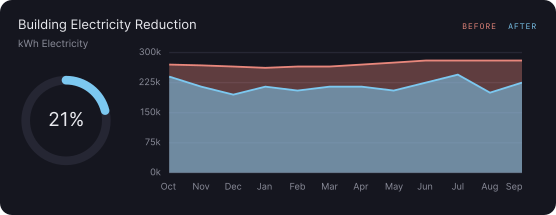
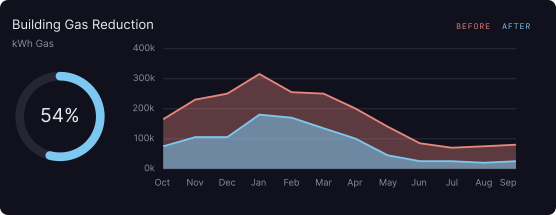
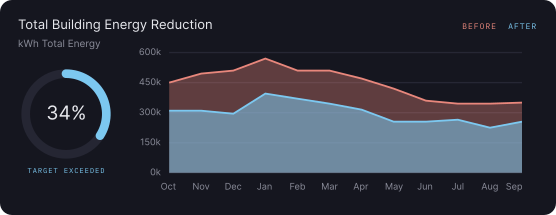
Summary
Symphony deployed its smart optimisation technology across the building’s HVAC systems, complemented by targeted upgrades to the chilled water system.
The result: a 34% reduction in total building emissions and a 54% reduction in gas consumption - exceeding PwC’s 2030 gas-reduction target of 50%.
The solution also delivered substantial BACS compliance in compliance with the recast EPBD requirements.
With SEAI EXEED grant support, the project’s payback period fell from five years to less than four - aligning decarbonisation with commercial common sense.
The Data – Before Symphony
- Total Building Electricity3.242,600 kWh
- Total Building Gas2.074,120 kWh
- Data Centre (IT load)372.000 kWh
- Data Centre (gas cooling load)446.400 kWh
- Data Centre Total818.400 kWh
- EUI (whole building)236 kWh/sqm/yr
- EUI (excl. Data Centre)201 kWh/sqm/yr
- Data Centre as % of Total Energy15%
- Data Centre floor area100 sqm
The Data – After Symphony
- Total Building Electricity2.570,330 kWh
- Electricity Reduction (whole building)↓ 21%
- Electricity Reduction (excl. Data Centre)↓ 33%
- Total Building Gas956.730 kWh
- Gas Reduction↓ 54% — 2030 target exceeded ✓
- Total Building Emissions Reduction↓ 34% — project target met ✓
- Emissions Reduction (excl. Data Centre)↓ 37%
- EUI (whole building)156 kWh/sqm/yr
- EUI (excl. Data Centre)135 kWh/sqm/yr
- Note: Figures exclude increased staff presence from back-to-office requirements. Additional staff office presence vs pre-Symphony: 6–8%, with longer days in office.
Projects Insights
Objectives Met — Exceeded
2030 Target Exceeded:
PwC's 2030 emissions target surpassed - ahead of schedule and within commercial constraints.
Self-Funded by 2030:
By 2030, accumulated savings will have fully paid for the project - commercial common sense delivered.
Data Centre Resilience:
Improved Data Centre resilience with an independent dual-purpose cooling source now in place.
Empowered FM Team:
Symphony Cloud tools enabling more proficient, data-driven maintenance and faster fault resolution.
Improved Comfort & Plant Life:
Better comfort from Symphony algorithms; longer plant life from more relaxed, optimised operation.
EPBD BACS Compliance Uplift:
Recast EPBD BACS compliance substantially achieved as a default outcome of Symphony Cloud.
Wider Benefits Beyond the Energy Bill
Symphony Cloud:
A bespoke HVAC management solution built on the Symphony Cloud platform, empowering PwC's FM team’s proficiency.
Maintenance:
PwC FM & Aramark empowered to identify underlying maintenance issues faster and fix them more proficiently.
Metering:
Energy metering incorporated on Symphony Cloud — systems and consumption tracked together in one place.
Comfort & Insights:
Enhanced maintenance capabilities yielding improved comfort; deep HVAC visibility driving faster, better decisions.
EPBD BACS Compliance:
Symphony Cloud ensures substantial recast EPBD BACS compliance by default — a significant regulatory dividend.
Net Savings Are Higher When All Factors Are Included
The headline energy figures don't tell the full story — several real-world factors mean the true net saving is even greater.
Substantial Comfort Uplift:
The building is warmer during winter and cooler during summer - a meaningful improvement in occupant experience delivered alongside the energy savings.
Increased Office Use Intensity:
Back-to-office requirements have driven more staff per day and longer stays - higher occupancy loads that would ordinarily push energy consumption up.
Additional VRF Cooling Added:
An extra top-up cooling VRF system was installed to ensure comfort in the Hospitality Suite during high-usage periods — an additional load on the system.
Roof Solar PV Offset:
A solar PV installation was implemented immediately prior to Symphony, providing some offset that partially contributes to the measured reduction.


